







Download our free bull put spread calculator to evaluate credit spreads with precision.
Calculate maximum profit, maximum loss, breakeven points, and annualized returns instantly. Perfect for both trending and swing trading strategies.
Contents
- Introduction to Bull Put Spread Calculators
- Understanding Bull Put Spreads
- Key Metrics Calculated by the Tool
- Download the Free Bull Put Spread Calculator
- Two Trading Methodologies for Bull Put Spreads
- Bull Put Spread Calculator Example (SPY)
- FAQs About Bull Put Spread Calculators
Introduction to Bull Put Spread Calculators
A lot of people are trading bull put spreads these days so I wanted to share my bull put spread calculator that I use to evaluate these trades.
If you click on the link below you can download my credit spread calculator that can be used for both bull put spreads and bear call spreads.
Having a reliable calculator is essential for any serious options trader because it eliminates calculation errors and helps you compare multiple trade setups quickly before committing capital.
Understanding Bull Put Spreads
When trading bull put spreads (and any options strategy for that matter) it’s important to know your maximum risk and potential profits.
A bull put spread is a bullish strategy also referred to as a credit spread due to the fact that you receive option premium (a credit into your account) after placing the trade.
Key Characteristics of Bull Put Spreads:
Structure:
- Sell a higher-strike put option (closer to current price)
- Buy a lower-strike put option (further from current price)
- Both options have the same expiration date
- Net result: You receive a credit
Risk Profile:
- Maximum profit: The net credit received
- Maximum loss: Strike width minus credit received
- Breakeven: Short put strike minus net credit
Generally most traders will set up their bull put spreads with out-of-the-money puts.
This means that their potential losses are more than the income they are bringing in for placing the trade, but the stock will have to decline, in some cases significantly, before experiencing losses.
Understanding options Greeks, particularly delta and theta, is crucial for selecting the right strikes for your bull put spreads.
Margin Requirements
Brokerages will require you to put up margin for bull put spreads.
At most brokerages, this will be equal to the amount of potential losses for the trade.
The attached calculator will show you how much margin you will be required to come up with, but you should check with your broker on how they calculate their margin requirements.
Key Metrics Calculated by the Tool
Our bull put spread calculator automatically computes all the essential metrics you need:
Primary Calculations:
- Net Credit (Cell C23) – The amount you receive for entering the bull put spread
- Short put premium MINUS long put premium
- This is your maximum potential profit
- Maximum Loss (C25) – The worst-case scenario if the stock drops below your long put
- Strike width minus net credit
- This is also your margin requirement at most brokers
- Breakeven Price (C27) – The exact stock price where you neither profit nor lose
- Short put strike minus net credit received
- Critical for risk management
- Percentage Return on Risk (C29) – Shows the return if the spread expires worthless
- (Max Gain / Max Loss) × 100
- Useful for comparing different trade setups
- Annualized Return (C31) – Converts the percentage return to an annual basis
- Accounts for days to expiration
- Helps compare trades with different time horizons
- Percentage Decline to Breakeven (C36) – Shows how far the stock can fall before you start losing money
- Critical risk metric for position sizing
- Helps you understand your margin of safety
Access Our Best Options Trading Resources
Before you download the calculator, get instant access to our comprehensive options trading guides:
Download the Free Bull Put Spread Calculator
Use this link to download the Bull Put Spread Calculator
Simply update the data in the green cells, and the calculator will instantly show you all the key metrics you need to make an informed trading decision.
Two Trading Methodologies for Bull Put Spreads
There are two primary approaches to trading bull put spreads, each with distinct advantages and risk profiles.
Trading with the Trend
Trading with the trend involves identifying a clear uptrend and then selling a bull put spread below recent support levels.
Advantages:
- Trade in the direction of momentum
- Higher probability of success
- Clear support levels to reference
- Not trying to catch a falling knife
- Aligns with the saying “the trend is your friend”
Disadvantages:
- Lower implied volatility means lower premiums
- Must place strikes closer to current price to generate income
- Less premium per dollar of risk
- Requires more capital for same income level
Best For:
- Conservative traders
- Those with larger accounts
- Traders prioritizing high win rates over high returns
Trading with the trend has advantages in that you have a clear uptrend to follow and you’re not trying to pick a bottom.
The downside of this method is that in an uptrend volatility will be low meaning lower option premiums.
As a result, in order to generate the same amount of income from your bull put spreads, you will need to place your strikes closer to the current stock price.
Swing Trading Against the Trend
When swing trading bull put spreads, you are trading against the trend and trying to (as near as possible) pick a bottom.
Advantages:
- Higher implied volatility equals larger premiums
- Can place strikes further from current price
- Better return on risk ratios
- More income per contract
- Capitalize on oversold conditions
Disadvantages:
- Higher risk of continued decline
- Fighting momentum
- Requires strong technical analysis skills
- Lower probability of success
- Must be prepared to adjust positions
Best For:
- Experienced traders
- Those comfortable with technical analysis
- Traders willing to accept lower win rates for higher returns
- Accounts where capital efficiency matters
The advantage of this method is that if a stock has been falling fast, volatility should swell meaning you can either receive a higher premium OR move further away from the current price.
Bull Put Spread Calculator Example
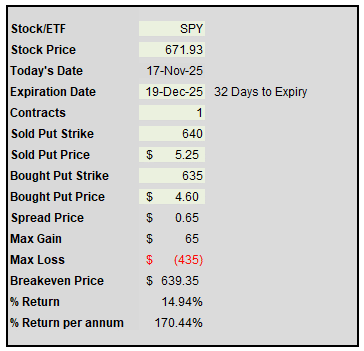
Let’s now look at an example of the bull put spread on SPY and see how the bull put spread calculator works.
Real Trade Example:
Date: November 17, 2025
SPY Price: 671.93
Expiration: December (approximately 32 days to expiration)
Options Prices:
- Dec 640 puts: $5.25
- Dec 635 puts: $6.60
Calculator Outputs:
Using the calculator, you enter the price of each option to see that a Dec 640-635 bull put spread could be sold for around $0.65 (cell C21).
Trade Metrics:
- Net Credit: $0.65 per share ($65 per contract)
- Maximum Loss: $4.35 per share ($435 per contract)
- Maximum Gain: $0.65 per share ($65 per contract)
- Breakeven: 639.35 (640 – 0.65)
- Return on Risk: 14.94% ($65 profit / $435 risk)
- Distance to Breakeven: 4.85% below current price
Trade Entry Considerations:
If you were entering the trade in your brokerage platform as a spread, this is the price ($0.65) you should enter to start with as it is the mid-point of the spread.
From there you can drop your price a little depending on how urgently you feel you need to get into the trade.
Otherwise you can leg into the trade by trading each contract separately.
The bull put spread calculator also shows you the maximum loss and maximum gain in dollar terms, as well as the potential percentage return if the spread expires worthless and also converts that return to an annualized return.
Another feature is that it shows you the percentage decline to your breakeven price allowing you to have a good understanding of your risk (Cell C36).
Ready to Master Credit Spread Trading?
Using a calculator is just the beginning.
To truly excel at bull put spreads and other credit strategies, you need a systematic approach:
- Options Income Mastery: Learn the complete framework for selecting strikes, timing entries, managing positions, and adjusting trades for consistent monthly income ($397)
- The Accelerator Program: Master advanced credit spread techniques, portfolio Greeks management, multi-leg strategies, and professional risk management across 12 months of comprehensive training ($997)
Both programs include detailed training on when to use bull put spreads versus other strategies, optimal position sizing, and adjustment techniques that protect your capital.
FAQs About Bull Put Spread Calculators
What information do I need to use the bull put spread calculator?
You only need four pieces of information:
- The price of the put option you’re selling (short put)
- The price of the put option you’re buying (long put)
- The strike prices (built into the option prices)
- Days to expiration (optional, for annualized return calculation)
What’s a good return on risk for bull put spreads?
This depends on your strategy and market conditions:
- Conservative (trending markets): 5-10% per trade
- Moderate (neutral markets): 10-20% per trade
- Aggressive (swing trading): 20%+ per trade
Remember to consider the probability of success and annualized returns when evaluating trades. A 10% return in 7 days is very different from 10% in 60 days.
How far should my strikes be from the current stock price?
This depends on your risk tolerance and strategy:
- Conservative: Sell puts 5-10% below current price (15-20 delta)
- Moderate: Sell puts 3-5% below current price (25-35 delta)
- Aggressive: Sell puts 1-3% below current price (40+ delta)
The calculator helps you evaluate different strike combinations to find your optimal risk/reward balance.
Should I use the mid-price shown in the calculator?
The mid-price is a good starting point, but actual execution depends on market conditions:
- In liquid options (SPY, QQQ), you can often get the mid-price
- In less liquid options, you may need to adjust toward the natural price
- Use limit orders and work your price
- Never use market orders on spreads
How do I know if my broker’s margin matches the calculator?
Most brokers require margin equal to the maximum loss (strike width minus credit). However:
- Some brokers have different requirements for portfolio margin accounts
- Regulations may vary for different account types
- Always verify with your specific broker before trading
The calculator shows standard margin, but confirm with your broker’s risk department.
What’s the best expiration to use for bull put spreads?
This depends on your trading style:
- Weekly traders: 7-14 days (faster returns, more management)
- Monthly traders: 30-45 days (balanced approach, most popular)
- Quarterly traders: 60-90 days (higher premiums, less frequent trades)
The calculator’s annualized return feature helps compare different expirations fairly. Most traders find 30-45 days optimal for balancing time decay and management requirements.
Conclusion: Evaluate Every Trade with Confidence
I hope you find this bull put spread calculator useful!
As always, if you have any questions, just drop me a line.
Key Takeaways:
- Always Calculate First: Never enter a trade without knowing your exact risk/reward
- Use the Right Metrics: Focus on percentage return, annualized return, and distance to breakeven
- Compare Multiple Setups: The calculator makes it easy to evaluate different strike combinations
- Match Strategy to Market: Use trending or swing trading methods based on market conditions
- Verify Margin Requirements: Confirm with your broker before committing capital
The bull put spread calculator eliminates guesswork and helps you make data-driven trading decisions.
Whether you’re trading with the trend in stable markets or swing trading in volatile conditions, having accurate calculations at your fingertips is essential for success.
Download the calculator today and start evaluating your bull put spreads like a professional trader.
Combined with proper risk management and a systematic approach, this tool will help you build consistent income through credit spread trading.
Related Articles
- Bull Put Spread Strategy Guide
- The Best Iron Condor Strategy
- Selling Put Options
- Wheel Options Strategy
- Option Credit Spreads Destroyed My Life
- Weekly Option Strategies
We hope you enjoyed this article on the bull put spread calcaultor.
If you have any questions, please send an email or leave a comment below.
Trade safe!
Disclaimer: The information above is for educational purposes only and should not be treated as investment advice. The strategy presented would not be suitable for investors who are not familiar with exchange traded options. Any readers interested in this strategy should do their own research and seek advice from a licensed financial adviser.



please send me the video to show how to use the calculator.
Also do u have calculator for Bull call spread and bear Put calculator and explanation of when can u use them
thanks
Ravi
Enjoyed your presentation. As a retired public accountant / PUT Option Seller, I’m having trouble
arriving at all your Percentages including return. Today (after paper-trading for a time) placed
my first Bear CALL Spread on CBI Mkt Value 58.63 (3 contracts) Expiration 5/22
59.00 CALL 1.05 , and
65.00 CALL .05 = Net 1.00 Credit.
I input the above in your Spread Calculator and the obvious Max. Gain was apparent but
all the other percentages and rationale I exhausted to arrive at the same or even close.
Any clarification would be appreciated. Larry